The science
A multisensory platform using scent, sound, and coloured light is more effective in engaging brainwave activity for a desired result compared to using a single sensory stimulus.
Zenaura SenseSpa exploits two laws of physics: the law of Frequency Following Response (FFR) and the Law of Resonance.
A multisensory platform using scent, sound, and coloured light is more effective in engaging brainwave activity for a desired result compared to using a single sensory stimulus.
Zenaura SenseSpa exploits two laws of physics: the law of Frequency Following Response (FFR) and the Law of Resonance.

Brainwaves are the gateway to measure how we feel
Brainwaves are patterns of electrical activity in the brain, created by the communication between neurons. These electrical impulses can be measured using devices like electroencephalograms (EEGs). Brainwaves are categorized based on their frequency, measured in hertz (Hz), and are associated with different physiological, mental and emotional states.
When we are particularly happy, our brain emits Gamma waves. When we feel great peace, our brain emits Delta waves.
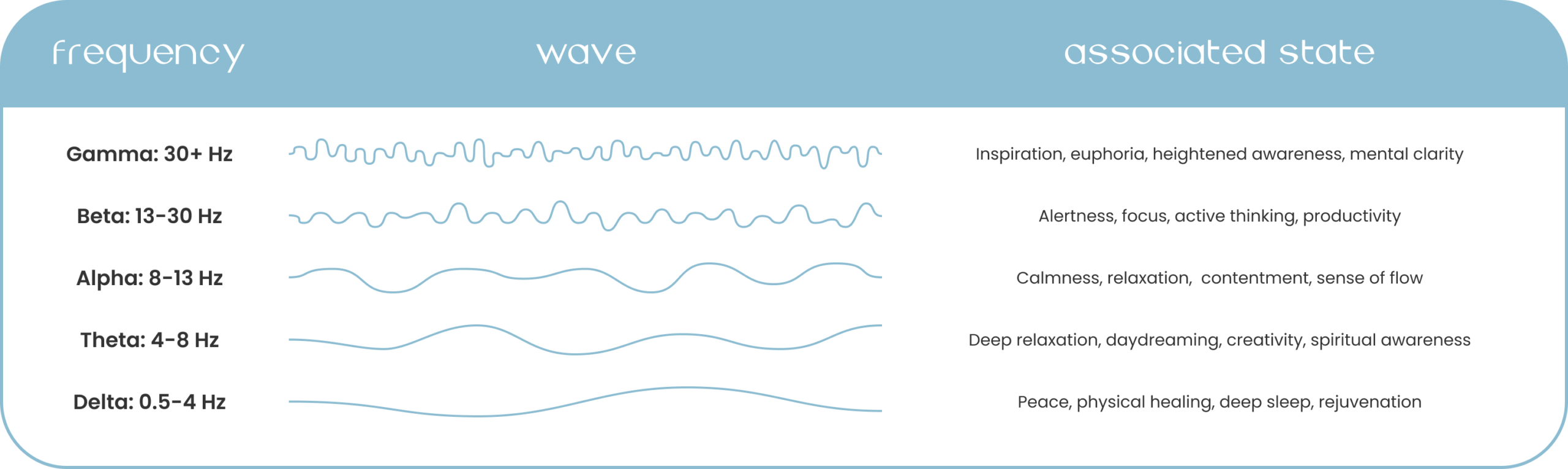
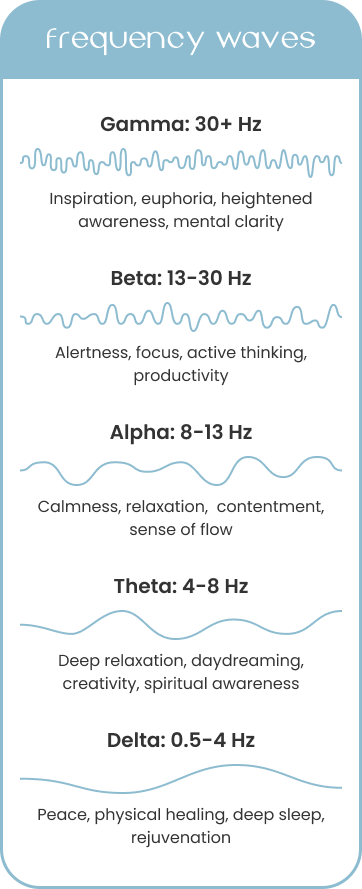
You can activate brainwave activity using external sources.
In physics, it is called the Law of Frequency Following Response (FFR)
This refers to the synchronization of your brain’s electrical activity with external stimuli. It’s a physiological response where the brain “follows” or synchronizes with a repetitive stimulus, such as a scent, sound or light. For example, when exposed to theta wave stimuli, the brain begins to resonate at that frequency, promoting relaxation.
You can generate a Frequency Following Response using outside sources of scent, sight and sound:
- Smell is based on the vibrational frequencies of odor molecules. The vibrational energy of a molecule helps receptors differentiate between similar molecules.
- Light involves detecting electromagnetic wave frequencies.
- Hearing involves detecting sound wave frequencies (vibrations in air pressure).
While sound and light directly stimulate brainwave activity through entrainment, scent influences brainwave activity indirectly by triggering physiological responses through the limbic system.
Combining these three modalities creates a multi-sensory experience that enhances brainwave modulation.
Sources
Sources of frequency following responses (FFR) in man H Sohmer, H Pratt, R Kinarti 1977
Evolving perspectives on the sources of the frequency-following response Emily B. J. Coffey, Trent Nicol, Travis White-Schwoch 2019
The frequency-following response: a window into human communication N Kraus, S Anderson, T White-Schwoch - 2017
Principles of Neural Science, Eric R. Kandel, James H. Schwartz, and Thomas M. Jessell 1981


When you activate more than one source the desired effect is
largely amplified. It is called the Law of Resonance
Resonance occurs when a vibrating system (like soundwaves) matches the natural frequency of a second system (like light waves or scent vibration), causing the second system to oscillate with greater amplitude. As an example, when sound waves are set to Theta frequency (or any other frequency) in order to feel relaxed, and you add Scent and Sight geared to the same Theta frequency, the combined effect of the three sources will amplify the person’s neural activity, which allows fast synchronization with the external stimuli. This is because when multiple senses are engaged, the brain’s sensory integration areas (thalamus and sensory cortices) become more active, hence Theta waves are amplified and you feel more relaxed, faster.
In synthesis, when the brain processes and integrates input from multiple senses simultaneously, it creates a more immersive experience that enhances brainwave entrainment and emotional engagement.
By combining sound, colored light, and scents, you can create an immersive environment to activate and enhance specific brainwave states. This multi-sensory approach leverages direct (sound and light) and indirect (scents) entrainment.
Sources
Mechanical resonance: 300 years from discovery to the full understanding of its importance J Bleck-Neuhaus 2018
The fall and rise of resonance science J Mortenson 2010


More into Brain’s sensory Integration areas
The brain’s sensory integration areas are specialized regions that process and combine information from multiple sensory modalities (e.g., vision, touch, hearing, taste, and smell). These areas allow us to perceive and respond to the world in a coherent way. Key sensory integration areas include:
1. Primary Sensory Areas
These are the initial cortical regions that receive sensory input from the respective senses:
- Primary Visual Cortex (Occipital Lobe): Processes visual information.
- Primary Auditory Cortex (Temporal Lobe): Processes sound signals.
- Primary Somatosensory Cortex (Parietal Lobe): Processes smell, touch, temperature, and pain.
While these areas handle single-modal processing, they send data to association areas for integration.
2. Association Areas for Multisensory Integration
These regions combine sensory inputs to create a unified perception:
- Primary Visual Cortex (Occipital Lobe): Processes visual information.
- Primary Auditory Cortex (Temporal Lobe): Processes sound signals.
- Primary Somatosensory Cortex (Parietal Lobe): Processes smell, touch, temperature, and pain.
While these areas handle single-modal processing, they send data to association areas for integration.
3. Subcortical Structures
These structures also contribute to sensory integration:
- Thalamus: Acts as a relay center, directing sensory inputs to specific cortical areas.
- Superior Colliculus: Integrates visual and auditory stimuli to coordinate eye and head movements.
4. Multisensory Integration Networks
- The default mode network (DMN) and salience network are thought to coordinate sensory information for complex cognitive and emotional responses.
- Specific integration often occurs at multisensory neurons, found in regions like the superior colliculus and STS.
These integration areas are essential for tasks like understanding speech, navigating environments, or interpreting the relationship between sight and touch.